


Face serum vs moisturizer is not really about choosing one over the other. A serum is generally used to target specific skin concerns with concentrated ingredients, while a moisturizer helps hydrate skin and reduce moisture loss. Depending on your skin type and goals, you may benefit from using both.
If you’re wondering whether you need a serum, a moisturizer, or both, the answer depends on what your skin actually needs. At Wildflower Naturals, products such as Kumkumadi & Donkey Milk Face Serum with 10% Niacinamide & 2% Alpha Arbutin and Kumkumadi & Donkey Milk Brightening Face Cream with Hyaluronic Acid + Rosehip Oil can fit different steps of a thoughtful routine. But first, let’s settle the confusion.
Face Serum vs Moisturizer: The Quick Difference
Think of skincare as having different jobs. A serum is usually the more targeted step, while a moisturizer is the comfort-and-protection step that helps maintain hydration.
|
Factor |
Face Serum |
Moisturizer |
|
Main purpose |
Targets specific skin concerns |
Hydrates and helps reduce moisture loss |
|
Texture |
Usually lightweight |
Cream, lotion, gel or richer texture |
|
Focus |
Active or targeted ingredients |
Hydration and barrier support |
|
Best suited for |
Specific concerns such as dullness or uneven tone |
Dryness, tightness and everyday hydration |
|
Routine position |
Usually before moisturizer |
Usually after serum |
The distinction is useful, but it is not a strict rule. Some serums are deeply hydrating, and some lightweight moisturizers contain active ingredients. What matters most is the formulation and what your skin needs.
What Is a Face Serum?
A face serum is a skincare product designed to deliver selected ingredients in a lightweight formula. Instead of trying to do everything at once, a serum is often built around a particular purpose, such as hydration, brightening or improving the appearance of uneven skin tone. Wildflower Naturals offers a dedicated range of face serum for women built around this targeted approach.
That makes a serum especially useful when you have a specific concern you want to address.
For example, Kumkumadi & Donkey Milk Face Serum with 10% Niacinamide & 2% Alpha Arbutin combines niacinamide and alpha arbutin with Kumkumadi and donkey milk. Wildflower Naturals positions this formula around the appearance of uneven tone, dullness, and rough texture.
What Does a Face Serum Do?
The answer depends on its ingredients. A hydrating serum may help skin feel more comfortable and supple, while a brightening-focused formula may be chosen when dullness or uneven-looking tone is the main concern. If you're still deciding whether to add one to your routine, this breakdown of face serum benefits can help clarify what to expect.
This is why choosing a serum simply because it is popular can be less useful than choosing one according to your actual skin goals.
What Is a Moisturizer?
A moisturizer is primarily concerned with keeping skin hydrated and helping limit moisture loss. It can make skin feel softer, smoother, and more comfortable, particularly when dryness or tightness is an issue.
Moisturizers come in different textures. A gel may suit someone who dislikes a heavy finish, while a richer cream can be more comfortable for dry skin.
For example, Skin Renewal Cream with Vitamin C is formulated with ingredients including aloe vera, shea butter, green tea extract, saffron, turmeric, licorice root extract and vitamin C. Wildflower Naturals lists it as a nourishing cream for normal to dry skin and describes its role around hydration, nourishment and improving the appearance of tired or dry-looking skin.
Another option, Kumkumadi & Donkey Milk Brightening Face Cream with Hyaluronic Acid + Rosehip Oil, appears in Wildflower Naturals' current face-care range.
Why Does Moisturizer Matter?
Even if your skin is oily, hydration still matters. Oily skin can produce excess sebum while still feeling dehydrated. Skipping moisturizer altogether is therefore not automatically the solution.
The better approach is to consider the texture, ingredients and amount you use.
Face Serum vs Moisturizer: Which One Is Better?
There is no universal winner.
If your main goal is to introduce a targeted ingredient into your routine, a serum may be the more relevant addition. If your skin feels dry, tight or uncomfortable, a moisturizer may deserve greater attention.
And if you have both a specific concern and a need for hydration, there is no reason to force yourself to choose.
The most useful question is not “Which product is better?” but “What does my skin need at this stage?”
Can You Use Serum and Moisturizer Together?
Yes. In fact, using them together is one of the simplest ways to give each product a distinct role.
A typical routine can look like:
Cleanse → Serum → Moisturizer → Sunscreen
The serum comes first because it is generally the lighter, treatment-focused step. The moisturizer follows to provide hydration and help keep the routine comfortable.
However, more products do not automatically mean better skincare. If your routine already contains several active ingredients, adding another serum simply because it is trending may create unnecessary complexity.
Start with what you need and give your routine time.
What Goes First: Serum or Moisturizer?
Usually, serum goes before moisturizer. If you're new to layering actives, this guide on how to use face serum walks through the basics.
After cleansing, apply your serum according to the product instructions. Once it has settled into the skin, follow with moisturizer. In the morning, finish with sunscreen.
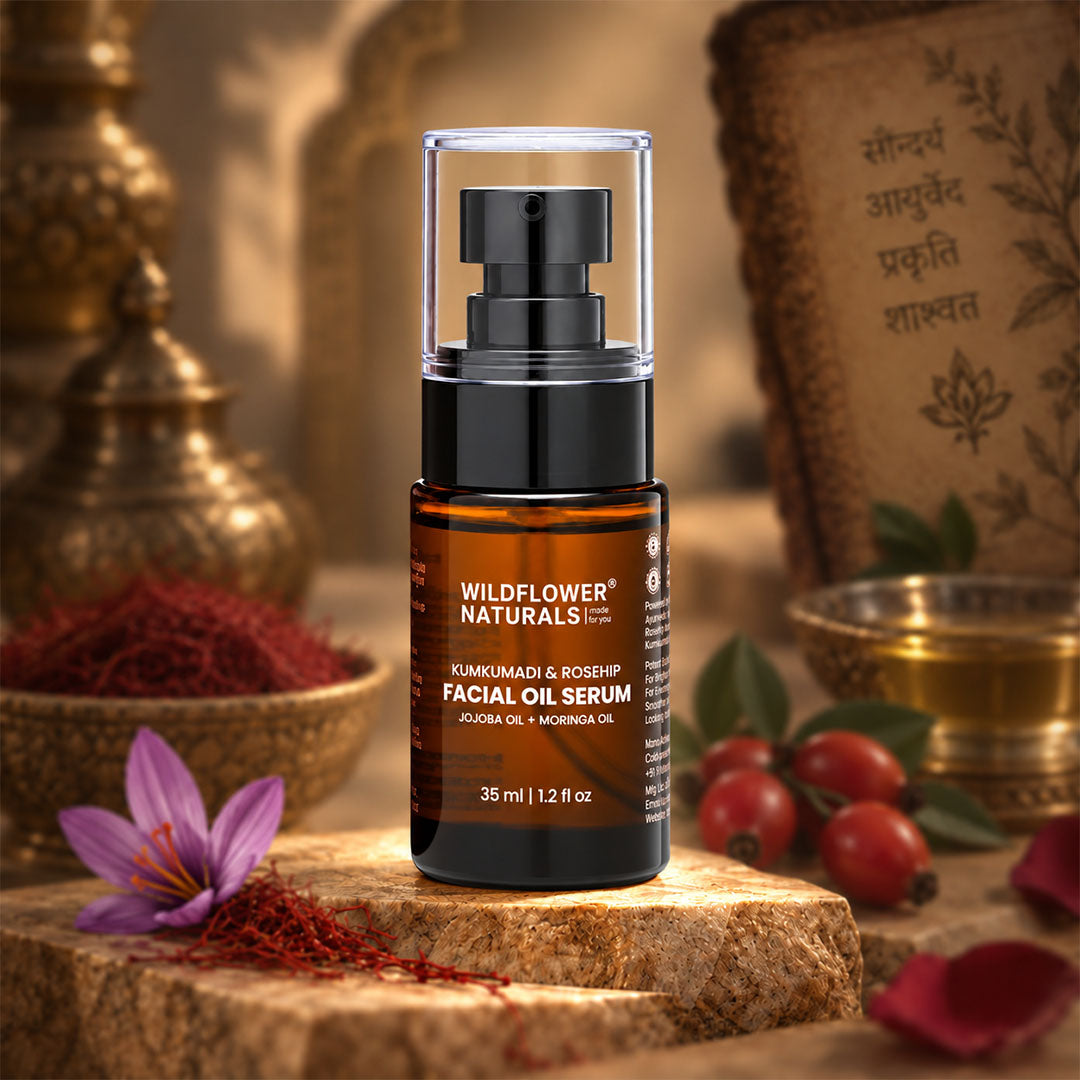
For instance, Wildflower Naturals' Kumkumadi & Rosehip Facial Oil Serum with Jojoba Oil + Moringa Oil instructs users to apply 2–3 drops after cleansing and toning, followed by moisturizer if desired and sunscreen during the day.
The important point is not to obsess over waiting a specific number of minutes between products. Apply each layer gently and allow it to settle before moving on. For a clearer sense of timing within a broader routine, see this guide on when to apply face serum.
How to Choose Between Serum and Moisturizer for Your Skin Type
Your skin type can make the decision much easier.
Dry Skin
Dry skin often benefits from a routine built around hydration and nourishment. A moisturizer should usually be a consistent part of the routine, while a suitable serum can add targeted hydration or address another concern.
Kumkumadi & Rosehip Facial Oil Serum with Jojoba Oil + Moringa Oil is one option to consider when nourishment is a priority. Its formulation includes rosehip, jojoba and moringa oils, and Wildflower Naturals lists it for dry and dehydrated-looking skin as well as other skin types. You can browse the full range of face serum for dry skin to find a suitable option.
Oily Skin
Oily skin still needs hydration, but texture matters. Look for lightweight formulas that do not leave your face feeling unnecessarily coated.
A serum can be useful when you want targeted care without adding a very rich layer, while a lightweight moisturizer can help maintain hydration. Wildflower Naturals' collection of face serum for oily skin is formulated with this lightweight approach in mind.
Combination Skin
Combination skin may need different things at different areas of the face. You may prefer a lighter moisturizer across the T-zone and a more nourishing layer where skin feels dry.
Keep the routine simple rather than applying every product everywhere.
Sensitive Skin
Sensitive skin benefits from a cautious approach. Introduce one new product at a time, patch-test when appropriate, and avoid building a routine around multiple strong actives at once.
If your skin is persistently irritated, painful or unusually reactive, skincare advice from a qualified dermatologist is more appropriate than experimenting with additional products.
Normal Skin
If your skin is generally comfortable and balanced, you do not need a complicated routine. A basic moisturizer may be enough for everyday care, with a serum added when you have a particular concern you want to address. Men looking for a targeted addition can explore Wildflower Naturals' face serum for men collection.
Face Serum vs Moisturizer for Different Skin Concerns
Your concern can be even more useful than your skin type when deciding what to add.
For Dull-Looking Skin
A targeted serum may be useful when dullness is your primary concern. Ingredients such as niacinamide or alpha arbutin are commonly included in brightening-focused formulations.
Wildflower Naturals' Kumkumadi & Donkey Milk Face Serum with 10% Niacinamide & 2% Alpha Arbutin is formulated around this type of targeted routine.
For Dryness and Dehydration
This is where moisturizer becomes particularly important. A hydrating serum can complement it, but it should not automatically be treated as a replacement.
For Rough-Looking Skin
A balanced routine can help improve how skin feels and looks over time. Avoid piling on multiple exfoliating or active products simply because you want faster results.
For Uneven-Looking Skin Tone
A targeted serum may make more sense than changing your entire routine. Look for ingredients that are appropriate for your concern and use them consistently according to their instructions.
Can a Serum Replace a Moisturizer?
Sometimes a hydrating serum may make skin feel moisturized, but that does not mean it performs the same role as a moisturizer.
If your skin is comfortable with a simple serum-only routine, you may not always need a separate cream. But if your skin feels dry, tight or easily loses moisture, keeping a moisturizer in the routine can be worthwhile.
Your skin's response should guide the decision.
Is Moisturizer Enough Without a Serum?
For many people, yes.
If your skin is generally balanced and your main goal is maintaining comfortable, hydrated skin, cleanser, moisturizer and daytime sunscreen can form a perfectly reasonable routine.
A serum is an optional targeted step, not a compulsory entry ticket to good skincare.
Common Mistakes to Avoid
A few simple mistakes can make even a well-chosen routine feel ineffective:
- Using too many actives at once: More ingredients can mean more irritation, not better results.
- Skipping moisturizer because you have oily skin: Oily and dehydrated are not opposites.
- Applying too much serum: A few drops are often enough, depending on the formulation.
- Changing products too frequently: Give your routine time before judging it.
- Forgetting sunscreen: Morning skincare should include sun protection.
- Choosing products by trend alone: Your skin type and concern should come first.
- Expecting overnight changes: Consistency matters more than constantly switching products.
A Simple Morning and Night Routine
You do not need a ten-step routine to care for your skin.
Morning
Cleanser → Serum → Moisturizer → Sunscreen
For targeted care, you might use Kumkumadi & Donkey Milk Face Serum with 10% Niacinamide & 2% Alpha Arbutin, followed by a suitable moisturizer. Finish with Kumkumadi & Donkey Milk SPF 50 Dew Drops Invisible Sunscreen with Hyaluronic Acid + UVA + UVB + PA+++ Protection + Water Resistant, which is part of Wildflower Naturals' current face-care range.
Night
Cleanser → Serum → Moisturizer
At night, you can keep things uncomplicated. If nourishment is your priority, Kumkumadi & Rosehip Facial Oil Serum with Jojoba Oil + Moringa Oil can be incorporated according to its usage directions.
The right routine is the one you can follow consistently without making your skin feel overloaded.
Build a Routine That Makes Sense for Your Skin
The real answer to face serum vs moisturizer is less about picking a winner and more about understanding what each product contributes. Serum can bring targeted care to your routine; moisturizer can provide the hydration and comfort your skin needs every day. Sometimes you need one, and sometimes you need both.
At Wildflower Naturals, the idea is simple: choose skincare that fits your routine instead of forcing your skin into a complicated trend. Explore options such as Kumkumadi &a Donkey Milk Face Serum with 10% Niacinamide & 2% Alpha Arbutin, Kumkumadi & Rosehip Facial Oil Serum with Jojoba Oil + Moringa Oil, Skin Renewal Cream with Vitamin C, and Kumkumadi & Donkey Milk Brightening Face Cream with Hyaluronic Acid + Rosehip Oil to build a routine around your skin's needs. Wildflower Naturals current face-care collection brings these products together alongside other daily skincare essentials.
Your skincare routine does not have to be bigger. It just needs to make sense for your skin.
Frequently Asked Questions
Q1. How should I use serum and moisturizer together?
Cleanse first, apply serum, follow with moisturizer, and use sunscreen as the final daytime step.
Q2. Can I use serum without moisturizer?
Yes, depending on the serum and your skin's needs. If your skin feels dry or tight, a moisturizer may still be beneficial.
Q3. Is serum better than moisturizer?
No. Serum and moisturizer serve different purposes, so neither is universally better.
Q4. Will serum make my skin dry?
Not necessarily. It depends on the formulation, ingredients and how your skin responds to it.
Q5. What should I apply first, serum or moisturizer?
Serum generally goes first because it is usually the lighter treatment step.
Q6. Why do I need moisturizer if my serum is hydrating?
A hydrating serum and moisturizer can complement each other. A moisturizer can help maintain comfortable hydration and reduce moisture loss.
Q7. Can oily skin use both serum and moisturizer?
Yes. Choose lightweight, suitable formulations and adjust the amount according to how your skin feels.
Q8. What should I choose for dry skin: serum or moisturizer?
Moisturizer should usually be a core part of a dry-skin routine, while a suitable serum can be added for extra hydration or targeted care.




Leave a comment
This site is protected by hCaptcha and the hCaptcha Privacy Policy and Terms of Service apply.